
What Iron County Deed Records Put on File
The Register of Deeds files every recorded deed. That filing sits within a much larger collection of Iron County property records. An instrument names who conveyed, who received, and the land involved. That filing proves the document exists in the official record. It does not prove the parcel is free of other claims. Mortgages, estates, trusts, and company ownership can all sit inside the same chain. So read each deed beside its legal description and the filings around it.
| Deed Type | What It Does | Common Use |
|---|---|---|
| Warranty deed | Conveys the interest stated in the instrument with its stated warranties | Reviewing a recorded conveyance |
| Quitclaim deed | Transfers whatever interest the grantor has, without a warranty of title | Tracing a family or entity interest |
| Personal representative deed | Records a conveyance by an estate representative | Following a probate-related transfer |
| Trustee or entity conveyance | Shows a transfer involving a trustee, LLC, or other named entity | Matching the party name to the parcel chain |
| Transfer-on-death or decedent-interest filing | Records a transfer mechanism or interest tied to death | Researching an estate-related ownership change |
Not every instrument in the deed records is a deed. A mortgage records a security interest, while a satisfaction or assignment updates it later. Easements, restrictive covenants, liens, powers of attorney, plats, and certified survey maps also appear. Each can shape how a parcel's interests are understood. So a full deed search reaches past documents titled "deed." The reason is a property's complete history.
Iron County Deed Records Search Options in LandShark
LandShark allows more than an owner-name lookup. Pick the search mode matching the reference in hand, whether a parcel number or a recording date. Then compare the parties and legal description on the result before trusting it as the right instrument.
| Search mode | Useful starting detail | Record task |
|---|---|---|
| Grantor / grantee name | Business or last name, first name, middle initial | Trace a transfer or locate a party's instruments |
| Document number; date | Known filing number or date span | Open a specific filing or narrow a search |
| Book and page | Recorded volume and page reference | Retrieve a document by its citation |
| Parcel ID; address | Current county parcel or situs address | Find land-related filings when a parcel is known |
| Legal description; tract-book ID | Lot, section, tract, or abstract reference | Search historic or description-based records |
| Plat; tax lien | Plat name or tax-lien reference | Find recorded map or lien material |
The live application also filters by document type, instrument group, date range, and party role. The county's category labels live in the portal itself, so choose from the menu there rather than assuming any list is complete. Open the Iron County LandShark application to search the official index.
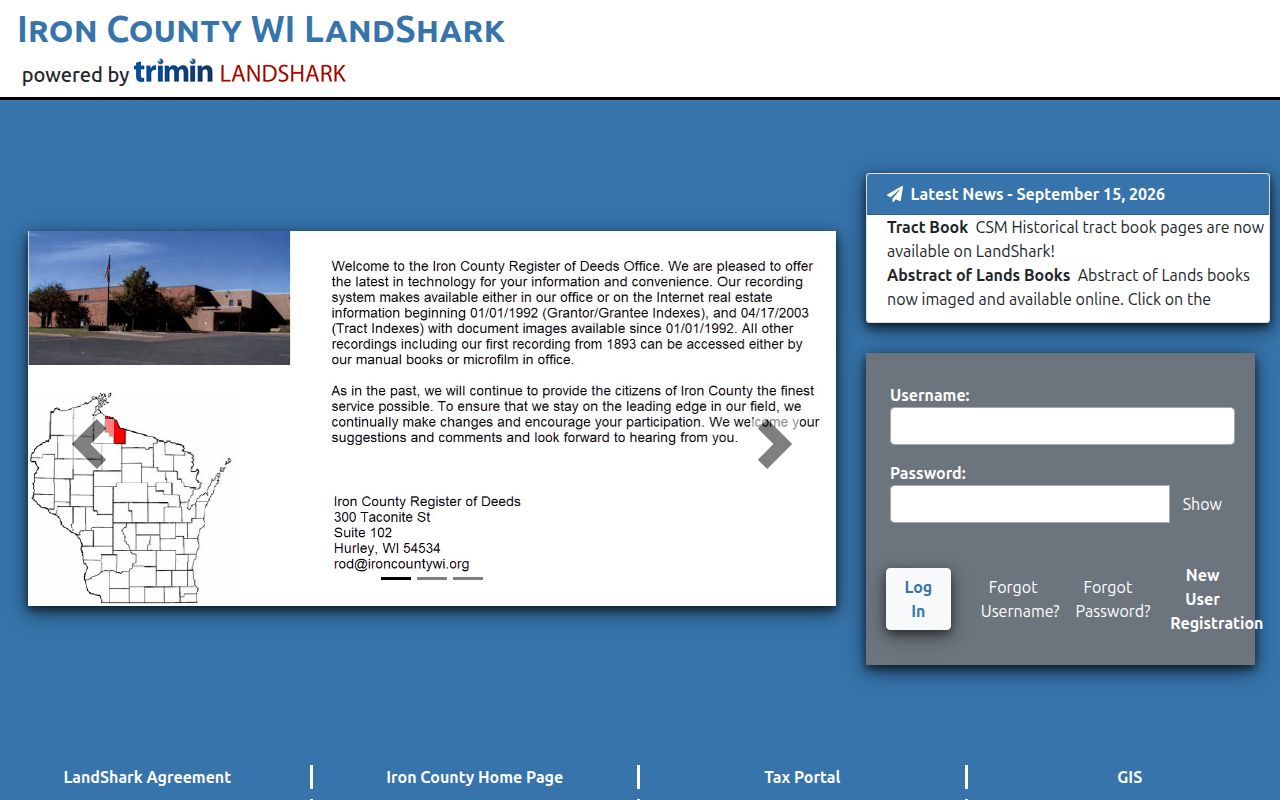
The search page itself displays no recorded instrument. Open the matching result, then request or download the document to confirm its parties, date, and legal description.
How Far the Iron County Deed Records Index Reaches
Computerized tract indexing in Iron County began in April 2003. Document imaging started that July. Older instruments are still being back-scanned and indexed as staff time allows. Those dates mark the start of modern systems, nothing more. They are not the birth of local land records. They are not a guaranteed cutoff for every document type. No official source states the earliest year any given parcel appears online.
When a search hits that boundary, hold onto the last known deed's recording reference, grantor, and grantee. Also note the parcel number and legal description. Those details let the Register of Deeds locate a specific older item. The county's abstract-book listing is another avenue. Note that the office's published policy rules out title searches and document interpretation. Take an incomplete chain to a title professional.
Following an Iron County Deed Record from Grantor to Grantee
The grantor-grantee index in LandShark records each party's role in every instrument. Start with a deed naming the current grantee. Work backward to that grantor's own deed into the chain. Then repeat with the preceding grantee. Search both roles whenever direction is unclear. The method rebuilds recorded transfers. But it will not resolve a gap, lien, or legal dispute by itself.
- Find the deed that names the known owner as grantee and compare its legal description with the parcel.
- Record the grantor, recording date, document number or book/page, and the land description.
- Search the grantor's earlier deed as a grantee, then compare the description and parcel history.
- Continue one transfer at a time and mark the point where the online index no longer supplies an earlier instrument.
- Grantor
- The party making the transfer or conveyance in the instrument.
- Grantee
- The party receiving the interest described in the instrument.
- Chain of title
- The sequence of recorded conveyances and related instruments for the land.
- Book/Page vs Instrument #
- Two ways a recorded document may be identified; use the reference shown by the county index.
Iron County Deed Records and Abstract Books
Iron County also lists 35 abstract-of-title books, numbered 1 through 107347. When an online chain runs dry in an older era, an abstract number can sharpen the next search. So can a book reference. An abstract may point to an earlier chain of instruments. It cannot replace examining the documents themselves or checking whether a parcel description later changed.
Historic descriptions often rely on a lot, block, or section. They may use a company location or an earlier tract reference instead of a modern street address. Search using the description from the last confirmed deed, and watch for spelling variants. If an early document is not viewable online, ask the office to locate it. Give them a book, page, abstract number, or party name. Leave title questions to the professionals.
Iron County Deed Records in Current Scanning and Indexing Work
A 2025 county board record earmarked $144,196.97 for a land-record modernization reserve. It approved scanning and indexing work with Trimin. That is a real investment in record access. It is not proof that every deed image is online. Back-scanning continues as time permits. A historic document can sit in county custody even when a portal search returns nothing.
When the first search comes up empty, change the key. Try the parcel ID, legal description, book and page, or document number. Then try the other party to the transfer. Lean on the abstract range or a focused request to the office. Keep notes on which instruments you checked and where the chain breaks. Staff can identify a record, but their published limits stop short of a title opinion.
Getting a Recorded Iron County Deed Record
LandShark is the county's online deed records tool. It finds a recorded deed by party name, parcel number, address, date, document number, book and page, or legal description. The county's 2019 viewing agreement lists a $2 charge to view a document. It also lists $1 to download it. Online terms can change, so check the current agreement and payment prompt before you begin. The Register of Deeds can also supply plain or certified copies. The fee schedule beyond the statutory recording charge is not published online, so ask the office before mailing payment.
A mail request to the Iron County Register of Deeds works best with specifics. Give the parcel's full legal description or the instrument reference. Name the parties, and state whether you want a plain or certified copy. Include a self-addressed stamped envelope so the office can return your documents. The statutory recording charge in the 2025 county record is $30. That fee covers recording only. Copy and search costs are separate.
Recorded, not guaranteed. The Iron County deed index reports recorded instruments, not every possible interest or a legal conclusion about title. Have a title professional examine the chain when ownership certainty matters.